1kV Flame-Retardant Thin-Wall Heat Shrink Tubing
RIKI 1kV flame-retardant thin-wall heat shrink tubing is available in 34 nominal sizes from Φ1.0/0.5 to Φ200/100 for electrical wire insulation and component covering. The catalog specifies VW-1 flame-retardancy performance, an initial shrink temperature of 90°C and six color options including green/yellow. Buyers should match expanded and recovered diameters to the actual component dimensions and verify the required material, flame-test documentation and supply length before ordering.
Why the Size Printed on a Heat Shrink Roll Is Not the Final Diameter
A purchasing list may specify “10 mm heat shrink tube” without explaining whether 10 mm refers to the supplied diameter, the finished diameter or the component being covered. For thin-wall tubing, that distinction determines whether the sleeve can be installed and whether it will recover to the intended fit.
RIKI supplies this flame-retardant range in nominal size codes from Φ1.0/0.5 to Φ200/100. The code identifies an approximate expanded-to-recovered size relationship, while the catalog’s separate dimension columns provide the actual published limits.
Use Both Diameter Columns
Take Φ10/5 as an example. The catalog specifies an inside diameter greater than 10 mm before shrinkage and no greater than 5.2 mm after unrestricted recovery. Its recovered wall thickness is 0.40 ± 0.08 mm.
The first diameter determines whether the tubing can pass over the intended part. The second helps establish whether sufficient recovery is available around the finished assembly. The tubing does not necessarily shrink to the free-recovery diameter when a wire, connector or other component occupies its interior.
A cable splice or irregular component may have a wider section than the adjacent wire insulation. In that case, the largest part the tubing must pass over may determine the minimum expanded diameter, while the smaller section that must be covered determines the required recovery capability.
Wall Thickness Becomes More Important as Sizes Increase
The catalog does not assign one wall thickness to the entire product family. For example, Φ4.0/2.0 has a published recovered wall thickness of 0.35 ± 0.05 mm, whereas Φ50/25 has a recovered wall thickness of 0.80 ± 0.10 mm.
This matters when material is purchased for a production drawing that specifies minimum insulation thickness or a limited finished outside diameter. The nominal tubing size and published wall tolerance should both be checked rather than relying on the general description “thin wall.”
The RIKI range provides dimensional options, but a finished assembly’s electrical performance cannot be calculated solely by multiplying the recovered wall thickness by the catalog’s material breakdown-strength figure.
Flame-Retardant Performance Needs the Correct Evidence
RIKI lists VW-1 under flame retardation in its technical specifications. It also publishes a tensile strength greater than 15 MPa, elongation at break greater than 300% and material breakdown strength of at least 25 kV/mm.
Those values provide useful comparison points when reviewing material samples. However, a VW-1 catalog entry is not the same as a verified product listing or an approval covering every size and color.
If the receiving manufacturer requires a specific UL, CSA or other certification, request the applicable test documentation and confirm its scope before treating the product as approved. The catalog does not provide a certification file number for this product.
Initial Shrink Temperature Is Not a Heat-Gun Setting
The technical table states 90°C as the initial shrinkage temperature. It does not specify a universal complete recovery temperature, heating duration or hot-air equipment setting for every size.
Production processes should be assessed against the tubing dimensions, the heat sensitivity of the wire or component underneath and the manufacturer’s installation guidance. Inconsistent heating can affect the final appearance and fit, particularly when multiple tubing diameters are processed on the same assembly line.
For bulk purchasing, an approved sample is more useful than selecting a heating temperature from a general internet guide. Confirm that the proposed process delivers the required covering without damaging adjacent components.
Six Colors — but Color Alone Does Not Define Function
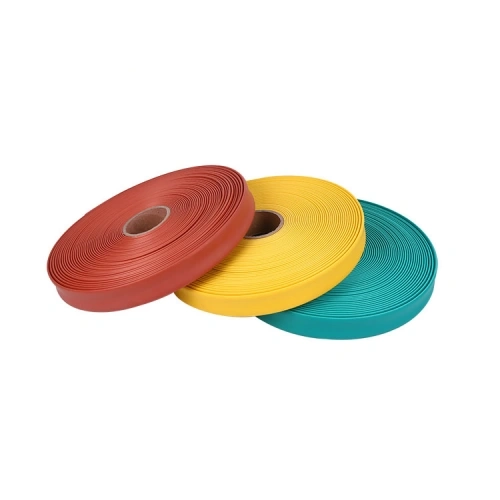
The RIKI catalog offers red, yellow, green, blue, black and green/yellow. These options allow buyers to specify different identification and insulation requirements within a wiring assembly.
The intended color arrangement should follow the electrical project’s conductor identification rules and the actual production drawing. A green/yellow sleeve must not be used as a substitute for verifying the protective conductor’s correct electrical connection.
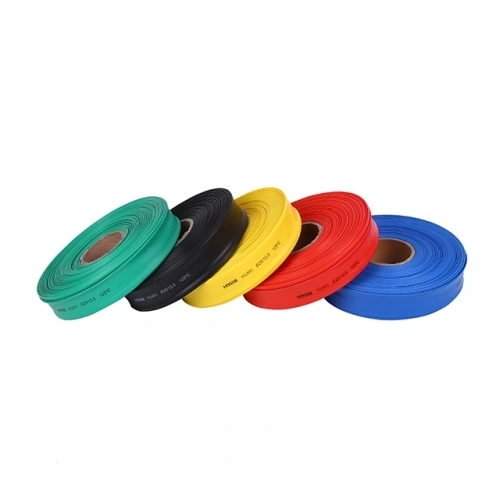
The product photograph displays five solid-color rolls. Green/yellow is a listed option in the catalog, but it is not shown in this particular photograph.
Thin-Wall Insulation Is Not Automatically a Sealed Joint
This product is intended for general insulating and protective sleeving applications. Although the catalog’s overview also mentions moisture protection, it does not publish an adhesive-lining specification or a completed assembly water-ingress test for this range.
A buyer requiring an environmental seal around a splice or cable entry should specify that performance separately. A dual-wall adhesive-lined product or another qualified sealing system may be necessary, depending on the application.
For volume orders: provide the component dimensions, chosen size code, color, required length and any necessary test documentation. The supplier should confirm packaging units, size tolerances and the approved material specification before the order is released.
1kV Thin-Wall Heat Shrink Tubing — Material and Performance Data
| Product Name | 1kV Flame-Retardant Thin-Wall Heat Shrink Tubing |
|---|---|
| Brand | RIKI |
| Manufacturer | Zhejiang Ruikai Electric |
| Product Category | Tubing & Busbar Insulation |
| Product Type | Flame-Retardant Thin-Wall Electrical Insulation Tube |
| Catalog Voltage Class | 1kV |
| Nominal Size Range | Φ1.0/0.5 to Φ200/100 |
| Number of Published Sizes | 34 |
| Nominal Shrink Ratio | Approximately 2:1; Actual Recovery Limits Follow the Size Table |
| Radial Shrinkage | >50% (Catalog Value) |
| Longitudinal Shrinkage | <10% (Catalog Value) |
| Initial Shrink Temperature | 90°C |
| Operating Temperature Range | -55°C to +105°C |
| Flame Retardation | VW-1 (Catalog Test Reference) |
| Tensile Strength | >15 MPa |
| Elongation at Break | >300% |
| Breakdown Strength | ≥25 kV/mm |
| Volume Resistivity | >1014 Ω·cm |
| Water Absorption | ≤0.1% |
| Available Colors | Red, Green, Yellow, Blue, Black, Green/Yellow |
| Standard Roll Length | Not Published — Confirm with Supplier |
| Adhesive Lining | Not Specified in the Catalog |
| Certification File Number | Not Provided in the Catalog |
| Item Code | Inside Diameter Before Shrink (mm) | Inside Diameter After Shrink (mm) | Wall Thickness After Shrink (mm) |
|---|---|---|---|
| Φ1.0/0.5 | >1.0 | ≤0.7 | 0.30±0.05 |
| Φ1.5/0.75 | >1.5 | ≤0.9 | 0.30±0.05 |
| Φ2.0/1.0 | >2.0 | ≤1.2 | 0.32±0.05 |
| Φ2.5/1.25 | >2.5 | ≤1.4 | 0.32±0.05 |
| Φ3.0/1.5 | >3.0 | ≤1.7 | 0.32±0.05 |
| Φ3.5/1.75 | >3.5 | ≤1.9 | 0.32±0.05 |
| Φ4.0/2.0 | >4.0 | ≤2.2 | 0.35±0.05 |
| Φ5.0/2.5 | >5.0 | ≤2.7 | 0.35±0.05 |
| Φ6.0/3.0 | >6.0 | ≤3.2 | 0.35±0.05 |
| Φ7.0/3.5 | >7.0 | ≤3.7 | 0.38±0.05 |
| Φ8.0/4.0 | >8.0 | ≤4.2 | 0.38±0.05 |
| Φ9.0/4.5 | >9.0 | ≤4.7 | 0.40±0.08 |
| Φ10/5 | >10 | ≤5.2 | 0.40±0.08 |
| Φ12/6 | >12 | ≤6.2 | 0.50±0.08 |
| Φ14/7 | >14 | ≤7.2 | 0.50±0.08 |
| Φ15/7.5 | >15 | ≤7.7 | 0.55±0.08 |
| Φ16/8 | >16 | ≤8.2 | 0.55±0.08 |
| Φ18/9 | >18 | ≤9.2 | 0.55±0.08 |
| Φ20/10 | >20 | ≤10.2 | 0.60±0.08 |
| Φ22/11 | >22 | ≤11.2 | 0.60±0.08 |
| Φ25/12.5 | >25 | ≤13 | 0.65±0.10 |
| Φ30/15 | >30 | ≤15.5 | 0.65±0.10 |
| Φ35/17.5 | >35 | ≤18 | 0.70±0.10 |
| Φ40/20 | >40 | ≤20.5 | 0.75±0.10 |
| Φ50/25 | >50 | ≤25.5 | 0.80±0.10 |
| Φ60/30 | >60 | ≤30.5 | 0.85±0.10 |
| Φ70/35 | >70 | ≤35.5 | 0.90±0.10 |
| Φ80/40 | >80 | ≤40.5 | 0.95±0.10 |
| Φ90/45 | >90 | ≤45.5 | 1.0±0.1 |
| Φ100/50 | >100 | ≤51 | 1.1±0.1 |
| Φ120/60 | >120 | ≤61 | 1.1±0.1 |
| Φ150/75 | >150 | ≤76 | 1.15±0.1 |
| Φ180/90 | >180 | ≤90 | 1.2±0.1 |
| Φ200/100 | >200 | ≤100 | 1.2±0.1 |
Frequently Asked Questions (FAQ)
Does Φ10/5 mean the tubing will always shrink to exactly 5 mm?
No. Φ10/5 is a nominal size designation. RIKI’s catalog specifies an inside diameter greater than 10 mm before shrinking and no greater than 5.2 mm after unrestricted recovery. The actual installed diameter depends on the component underneath the tubing. Buyers should check both dimensional limits rather than treating the model code as an exact finished measurement.
Does the VW-1 catalog rating mean this heat shrink tubing is UL certified?
Not by itself. The RIKI catalog lists VW-1 as a flame-retardancy test specification, but it does not provide a UL certification file number for this product family. If a project requires a particular recognized material or certified component, request the applicable documentation and confirm that the tested sizes, colors and product designation meet the actual specification.
Can the thin-wall tube provide a waterproof seal around an electrical splice?
A waterproof seal should not be assumed. Although the catalog mentions moisture protection, it does not specify an adhesive lining or a verified water-ingress rating for this product range. Applications requiring environmental sealing need a suitable qualified material and installation arrangement. Standard insulating sleeving should not automatically be substituted for adhesive-lined sealing tubing.
Is 90°C the recommended heat-gun setting for every tube size?
No. The published 90°C value is the initial shrinkage temperature, not a universal equipment setting or guaranteed complete recovery temperature. Heating requirements depend on tubing dimensions, the substrate and the approved processing method. For repeated production, the selected heating conditions should be validated on actual samples without damaging the protected wires or components.
Are all six colors available in every diameter and roll length?
The catalog lists red, green, yellow, blue, black and green/yellow as color options, but it does not confirm inventory or standard roll lengths for every size-color combination. Specify the exact diameter code, color and quantity in the RFQ. The available packaging length and any minimum order requirement should be confirmed before production or purchasing is scheduled.
Where Thin-Wall Sleeving Fits into Electrical Assembly Work
Wire Harness Insulation and Assembly
Thin-wall sleeving can cover suitable wire sections, prepared connections and component leads in electrical wiring assemblies. The expanded diameter must pass over the largest component in the intended covering area, while the recovered dimensions must fit the finished assembly.
Production check: Wire diameter, connection dimensions, sleeve length and required wall thickness.
Control Cabinet Wiring Identification
Colored tubing may be specified for identified conductor groups and wiring sections inside electrical control equipment. Color assignments must follow the actual wiring drawing and applicable project identification requirements.
Production check: Approved color schedule, printed marking requirements and finished sleeve position.
Electrical Component Lead Protection
Suitable tubing sizes can provide insulation covering for electrical component leads and connections where the material's temperature and dielectric characteristics match the application requirements.
Production check: Component temperature limits, insulation diameter and required material evidence.
Batch Cutting and Sleeving Operations
Electrical assembly manufacturers may purchase specified tubing sizes and colors for repeated cutting and heat-recovery operations. Consistent dimensions, documented tolerances and confirmed packaging lengths are important when the tubing is incorporated into a production process.
Production check: Roll or cut length, acceptable dimensional tolerances, process trials and incoming-material inspection requirements.