US federal mining rules define a splice as “the mechanical joining of one or more severed conductors in a single length of a cable.” The definition keeps going: “including the replacement of insulation and jacket.” Read that way, a splice is the whole repair. In everyday shop talk, the word can mean only the metal sleeve between two conductors.
The USDA Rural Utilities Service doesn’t separate the two words at all. Its underground distribution specification reads: “Cable joints/splices shall be of the pre-molded rubber, heat-shrink, or cold-shrink type, of the correct voltage rating.”
Our catalog calls the product a straight joint. Buyers in Mexico and Central and South America write “splice” on WhatsApp. In the inquiries we handle, they are asking for the full straight joint kit.
The word settles nothing. What settles an order is which layers of the cable the product puts back. Write those layers on the RFQ, and the joint-or-splice question goes away.
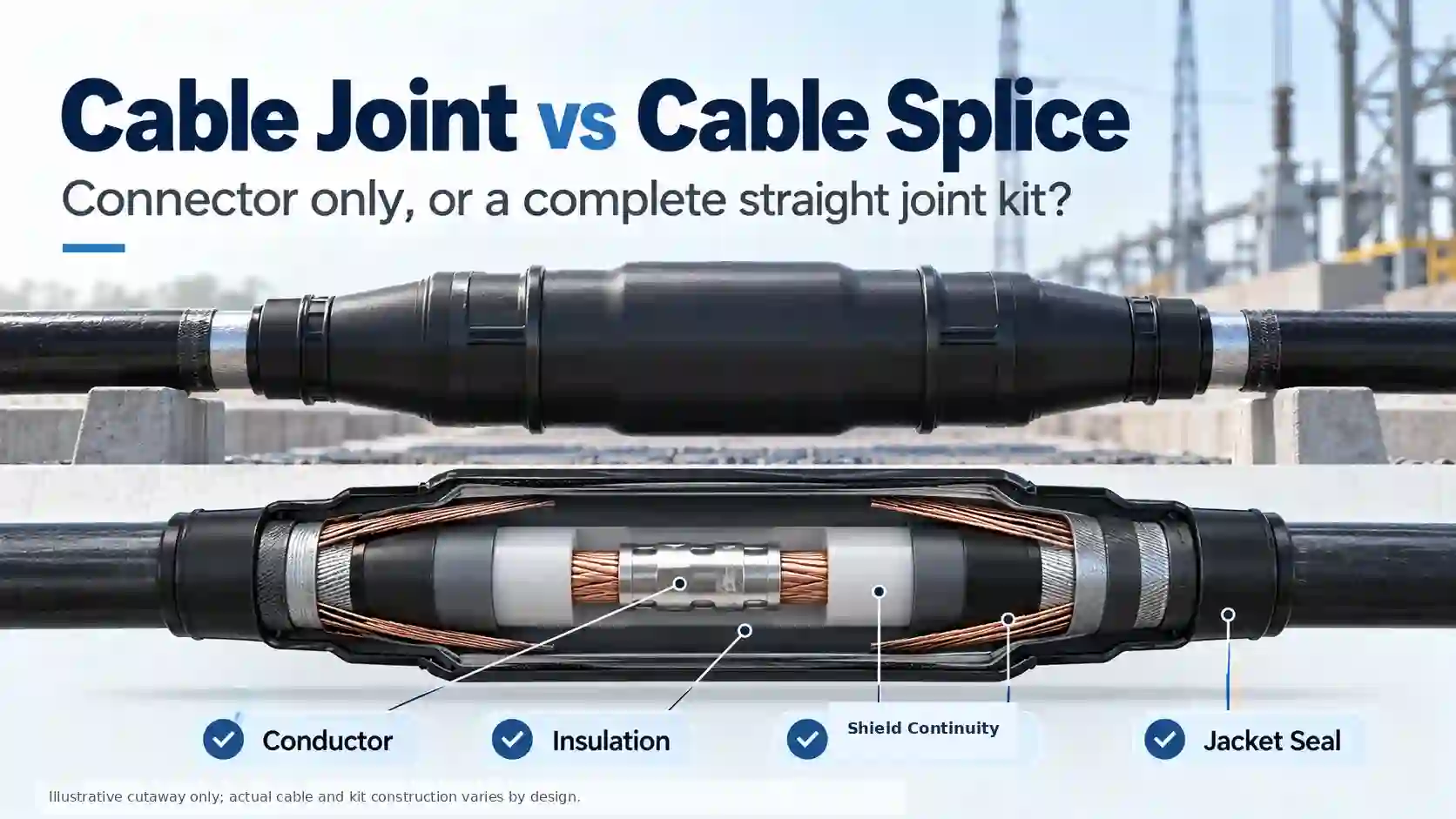
| Cable layer | What a conductor connector alone does | What a full straight joint does | What to write on the RFQ |
|---|---|---|---|
| Conductor | Joins the two conductors | Joins them, by connector or by welding | Connector included or not; crimp or bolted; Cu or Al |
| Insulation and stress control | Nothing | Rebuilds insulation and grades stress at the shield cut | Voltage class; insulation OD of both cables |
| Shield or concentric neutral | Nothing | Carries the shield or neutral across the joint | Shield form; whether the neutral carries load current |
| Jacket and moisture seal | Nothing | Restores the jacket and seals out water | Location: dry vault, wet duct, direct burial |
| Armour, if present | Nothing | Bonds the armour, when the kit is configured for it | Armoured or not |
The joint standard tests more than the connector. IEEE 404 sets ratings and test requirements for cable joints from 2.5 kV to 500 kV, and in it “test requirements for joint metallic-shield and jacketing components are defined.”
The conductor: crimped, bolted or welded
In our kits the conductor connector is an option. We supply crimp sleeves and bolted connectors, and we also sell them on their own. A buyer who already stocks connectors can order the joint body alone.
The choice follows the crew’s tools. A crimp sleeve is made for one conductor size and needs the matching die. A bolted connector clamps the conductor with bolts and accepts a range of sizes. If the crew already carries the die for that conductor, order the body without the connector. If not, ask for the connector in the kit and name the type.
Our JMM welded joint has no connector at all. The conductors are joined by exothermic welding, and the insulation and semi-conductive layers are rebuilt over the weld. Our catalog describes aluminium exothermic welding. We added this option after buyers asked for it. Customers do the welding on site, and we guide them through it.
The welded joint was tested at China’s National Wire and Cable Quality Testing Center against GB/T 12706.4. Our catalog lists these results for the 10 kV range:
- AC withstand: 55 kV for 5 minutes
- Partial discharge at 15 kV: not detected, background 0.65 pC
- Impulse: ±115 kV, 10 times each, at 95–100 °C
- Load cycling at 2.5 Uo: 30 cycles in air, then 60 cycles in 1 m of water
- Short circuit, 400 mm²: 43 kA for 3 seconds, twice, no damage
GB/T 12706.4 is a Chinese national standard. We don’t present this report as an IEEE 404 test.
Insulation and stress control
A heat-shrink joint rebuilds the insulation and the semi-conductive screen over it as tubes. Our heat-shrink joints use a composite tube that carries both layers in one piece. The reason our catalog gives is the gap: two separate tubes leave one between the layers, and a single composite tube removes it.
On the buying side, one number matters here. The insulation OD of each cable has to sit inside the joint body’s range. The same check applies to terminations, and our guide to medium voltage cable terminations shows how metric size bands line up with AWG and kcmil cables.
The shield and the concentric neutral
Federal rules for utility underground cable put the concentric wires in a specific role. The RUS cable specification covers 15 kV and 25 kV cable for “underground distribution systems with solidly multi-grounded neutral.” It requires that the “Concentric neutral conductor shall consist of annealed round, uncoated copper wires.” On that cable, the wires are a neutral conductor.
Electricians still split on this. In a 2007 Mike Holt forum thread, one called the concentric wires “a drain for any stray voltage.” Others said they are the neutral, tied to the overhead neutral at the poles. The thread settled on the cable type. On jacketed concentric neutral utility cable, the wires are both shield and neutral. On tape-shielded customer-side cable, the copper tape is a shield only.
In our kits, the shield or neutral is carried across the joint with a constant force spring or a braid. We make joints as an OEM, so the kit is matched to the customer’s cable. On concentric neutral cable, the neutral wires can instead be joined with their own connector outside the joint body.
Which method a job needs depends on what current the neutral carries, and that is a system design question. We don’t answer it from the sales desk, and buyers shouldn’t either. The system engineer decides whether the neutral carries load current and how much. Put that answer on the RFQ, and the kit gets matched to it.
The jacket and the water
The RUS specification was written for the rural utility systems it finances. It draws a hard line on sealing: “Joints/Splices that depend solely on tape for a moisture barrier shall not be used.”
In our cold-shrink joint, the silicone body seals onto the cable insulation by its own radial pressure. The layers over it come in options on the same drawing. The inner layer is either sealing waterproof tape or a heat-shrinkable inner sheath. The outer layer is either armoured tape or a heat-shrinkable outer sheath. Pick tape for both, and the jacket side of the joint relies on tape. Customers choose by the rules in their region, and we send samples before they commit. In Mexico, one inquiry came in for joints in an underground cable gallery.
If your project follows a specification like the RUS one, pick the heat-shrink sheath options and say so on the RFQ. If the joint will sit under water, ask for the test that covers submersion. The welded joint’s load cycling in 1 m of water is that kind of test.
Two cables, one joint
A 2024 thread on the Mike Holt forum lays out a common setup. The existing cable was 15 kV, 500 kcmil aluminium, with a tape shield and 133% EPR insulation. It had to be spliced to a new 500 kcmil aluminium cable with a concentric neutral. The poster wrote: “I told them to confirm with the engineers before buying but they still bought it and want to install it.”
We don’t make transition joints. When conductor sizes differ, the change is taken at the connector with an adapter, and a standard straight joint goes over it. That route has limits:
- Conductors. The adapter has to fit both conductor sizes. Copper to aluminium also needs a connector made for that pair of metals.
- Insulation OD. Both ODs have to fall inside the joint body’s range. A 133% insulation level on one side and 100% on the other can push them apart.
- Insulation type. Our catalog lists our cold-shrink joints for XLPE cable. An EPR cable on one side, as in that forum case, gets checked against the kit before we quote.
- Shield and neutral. A tape shield on one side and a concentric neutral on the other need a connection that suits both. The neutral question goes to the system engineer.
If any of these fails, the job needs a transition joint, and we say so and don’t quote a straight joint. Write both cables on the RFQ, one line each.
| What “splice” on an RFQ can mean | What ships | How to confirm |
|---|---|---|
| Connector only | Crimp sleeve or bolted connector | Conductor size and material, connector type |
| Joint body without connector | Insulation, stress control, shield and jacket parts | Insulation OD, shield form, location |
| Full straight joint kit | Body plus connector | Everything above, in one line |
| Joint across two different cables | Adapter at the connector, plus a straight joint | Both cables, side by side |
Listed in the US, approved in Canada
In the United States, Article 315 of the 2023 NEC covers medium voltage cable joints and carries listing requirements in 315.6. The 2026 edition moves listing rules into the .2 section of each article and prohibits reconditioned medium voltage cable joints, terminations and connectors. The section number on your job depends on the edition your jurisdiction has adopted. The code is published by NFPA, linked from its NEC page.
In September 2026 we had a run of inquiries from Canada. In each one, an early question was whether we hold CSA or cUL certification. Our answer is plain. We don’t own a listing for these joints. Our own UL covers 1 kV heat-shrink tubing only. For higher voltages we manufacture as an OEM for North American customers who hold the listing under their own names. Several buyers prefer exactly that route.
Alberta has written down what the certification picture looks like for these products. Its STANDATA variance 21-ECV-002-024, issued in August 2024 under Rule 2-024 of the 2021 Canadian Electrical Code, Part 1, states: “Canadian certified HVTS kits are not available.” It accepts non-certified termination and splice kits when the manufacturer declares testing to IEEE 48-2020 and IEEE 404-2022. Kits tested to another standard, such as IEC 60502-4, need a registered engineering professional to find that standard comparable. Installers follow the manufacturer’s instructions, and the variance puts weight on training from the manufacturer. The 2024 edition of the CE Code has since come into force, so ask the inspector which variance applies on your job.
On our side, that means an installation manual and remote video guidance. We rarely send anyone to site, because of the distance. Whether a remote session meets an inspector’s training requirement is for the inspector to decide. I don’t know whether other provinces have issued similar variances.
FAQ
Is a cable joint the same as a cable splice?
In power cable work, yes. US federal specifications write “joints/splices” as one term.
Does a straight joint kit include the conductor connector?
Not always. In our kits it is an option, either a crimp sleeve or a bolted connector, and it is also sold on its own. Ask the supplier to list the connector by type on the quote.
Can one joint connect two different cables?
Sometimes. The size change is taken at the connector with an adapter, and one straight joint covers both sides. Both insulation ODs have to fit the joint body’s range, and both insulation types have to be on the kit’s list. The shield or neutral of each cable also needs a connection that suits both. That matters when a tape-shield cable meets a concentric neutral cable. List both cables on the RFQ, and have the system engineer confirm the neutral before you buy. The 2024 forum case above shows what happens when that step comes after the purchase.
Where our part ends
We make the joint kits, connectors and adapters, and we guide installers by manual and remote video. We don’t design bonding, grounding or protection, and we don’t make joints on site. Ratings for the neutral and the bonding scheme come from the system designer. Send your cable details to our sales team, and browse our cold shrink and heat shrink cable accessories.
Sources
- US Code of Federal Regulations, 30 CFR 7.402 Definitions (mine electric cables and splice kits).
- USDA Rural Utilities Service, Bulletin 1728F-806, Specifications and Drawings for Underground Electric Distribution, effective 11 October 2018.
- US Code of Federal Regulations, 7 CFR 1728.204, RUS specification for primary underground power cable.
- IEEE Standards Association, IEEE 404, Standard for Extruded and Laminated Dielectric Shielded Cable Joints Rated 2.5 kV to 500 kV.
- NFPA, NFPA 70 (National Electrical Code), Article 315.
- ICC, 2023 NEC Changes, session list: “315.6 Listing Requirements”, “315.17 Marking for Type MV Cable Joints and Terminations”.
- IAEI Magazine, T. Domitrovich, NEC 2026 Significant Code Changes, 1 July 2025: listing requirements moved to section .2.
- IAEI Magazine, C. Hannahs, Stepping Up Medium Voltage Requirements in the NEC, 1 January 2026: reconditioned cable joints, terminations and connectors.
- Alberta Municipal Affairs, STANDATA Variance 21-ECV-002-024, HVTS Kits, August 2024, under Rule 2-024 of the 2021 CE Code, Part 1.
- Mike Holt Forum, “medium voltage cable question?”, July 2007.
- Mike Holt Forum, “Splicing two different MV cable together”, July 2024.
- Zhejiang Ruikai Electric Co., Ltd., product catalogue: welded joint test data, cold-shrink joint structure and cable type, heat-shrink composite tube.