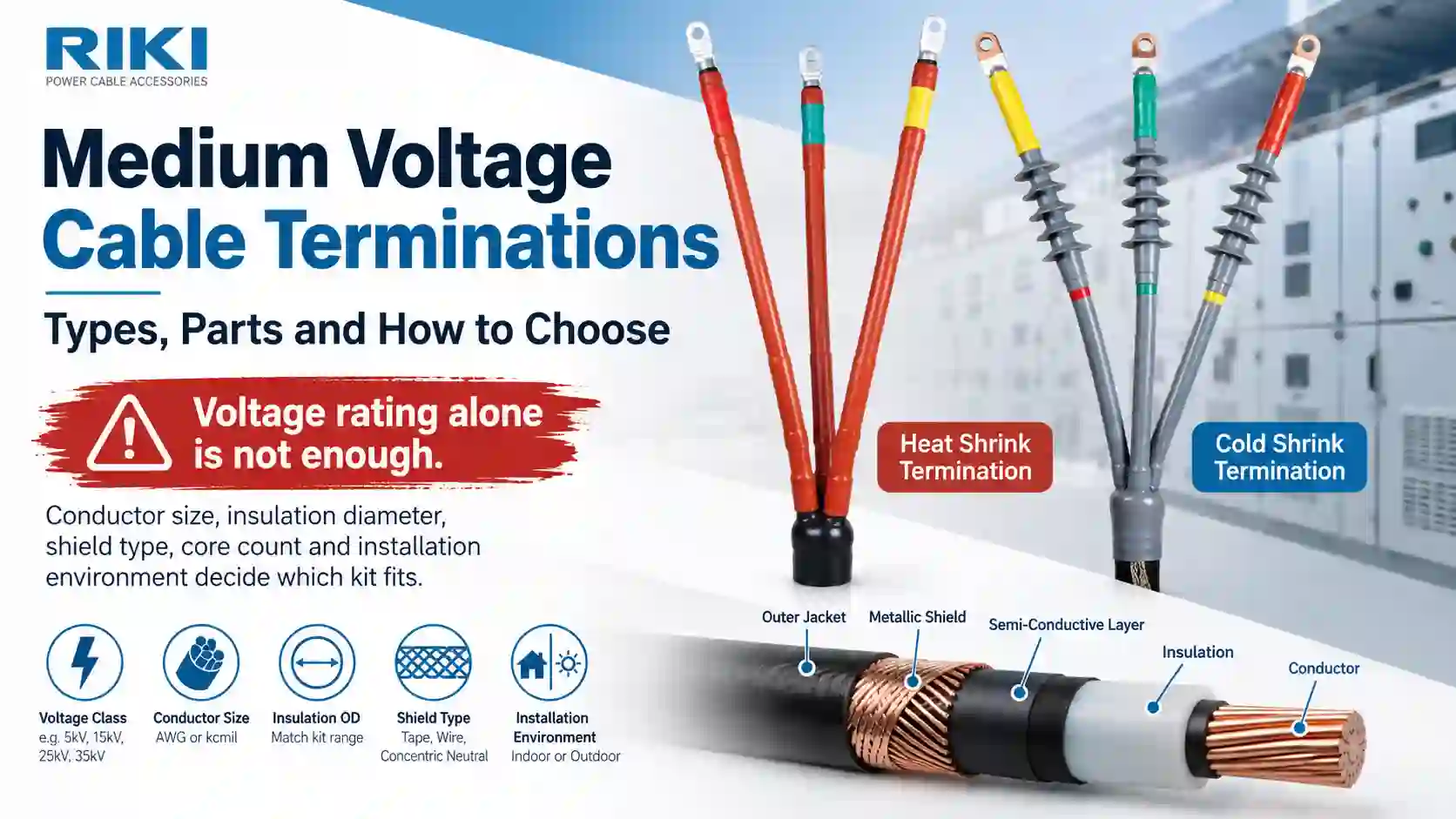
Can you pick medium voltage cable terminations from the voltage rating alone? No. Voltage gets you to the right page of a catalog. The kit on that page is chosen by several ranges checked together: conductor size, insulation diameter, shield form, core count and location.
We make heat-shrink and cold-shrink terminations and joints, plus separable connectors, at our plant in Yueqing, Zhejiang. We don’t choose the customer’s cable, and we don’t design the protection scheme around it.
| What you need to confirm | Where to find it | What goes wrong if it’s missing |
|---|---|---|
| Voltage class and insulation level (or Uo/U) | Cable datasheet | Kit rated for a different cable |
| Conductor size and material (Cu / Al) | Cable datasheet, cable schedule | Wrong lug barrel, wrong size band |
| Insulation diameter | Cable datasheet | Stress control and seal don’t grip the cable |
| Shield form (tape, wire, concentric neutral) | Cable datasheet, photo of cable end | Ground connection parts don’t match |
| Number of cores | Cable schedule, photo | Breakout and armour ground missing or wasted |
| Indoor or outdoor | Single-line drawing, site | Wrong creepage and sealing for the location |
| Local grounding rule | Utility or owner specification | Braid too narrow or too short on site |
What counts as a medium voltage termination
IEEE 48-2020 sets test requirements for “all indoor and outdoor cable terminations used on alternating-current shielded cables.” Its scope then carves out one family: separable insulated connectors, which it refers to IEEE 386.
A 200 A loadbreak elbow ends a cable too. It is still tested under a different standard from a heat-shrink outdoor termination. The two belong on different quote lines, with different reports behind them.
The family name in an inquiry tells us very little. On 13 October 2026 a buyer sent one line on WhatsApp: “American 200A connectors.” Before sending any catalog pages we asked where they would be installed and whether the order was for a project or for resale. The answers decided which pages went out.
Elbows and terminations rarely get mixed up on our line. Joints and terminations do, and the mix-up sits in the parts list. A buyer knows he wants a termination, then names a component from a straight-joint kit. We ask for a photo of the cable end plus the technical parameters, and check the list against both kits before quoting.
| Product | What it does | Test standard named for it |
|---|---|---|
| Termination | Ends a shielded cable at equipment or an overhead line | IEEE 48 |
| Separable connector (elbow, T-body) | Ends a cable on a bushing and can be separated | IEEE 386 |
| Straight joint | Connects two cable lengths | A separate joint standard; not covered here |
IEEE 48-2020 points to IEEE 386-2016. IEEE 386-2025 was published in June 2026 and supersedes it, while our own catalog still cites the 2006 edition on its connector pages. If your specification names an edition, write that edition on the RFQ.
Parts that change the quote
Take the drawing for our 10 kV (15 kV) three-core cold-shrink termination. It lists the terminal lug, sealing tube, terminal tube, jacket tube and breakout. Then come the shield ground wire, armour ground wire, constant force spring and stress cone. The heat-shrink version swaps the cone for a stress control tube and stress control adhesive. It adds insulation tubes, rain sheds and a heat-shrinkable breakout.
Both handle the electric stress where the cable shield is cut back. Okonite’s July 2004 technical note describes two routes. One builds geometry past the shield end, as a cone does. The other uses Hi-K polymer materials “to electrically grade termination stresses the same way a stress cone geometrically grades the stress.” For a buyer, the grading method comes with the product family you pick. You don’t need an RFQ field for it.
| Part | Its job | Does it change the quote? |
|---|---|---|
| Stress cone / stress control tube and adhesive | Grades electric stress at the shield cutback | No, it comes with the product family |
| Sheds and sealing | Creepage and moisture protection for the location | Yes, follows the indoor or outdoor rating |
| Breakout | Seals the crotch of a multi-core cable | Yes, multi-core cables only |
| Terminal lug | Connects the conductor to the equipment stud | Yes, follows conductor size, material and stud |
| Shield and armour ground wires, braid | Carry the shield and armour to ground | Yes, width and length follow local rules |
| Sleeves and tubes | Insulation and jacket cover | Yes, length and wall vary by region |
Two rows need a note. Shed count and sealing follow the location rating, and some indoor terminations carry sheds too, so go by the rating on the sheet. Our part numbers start with W for outdoor and N for indoor. Sleeve length and wall thickness are the dimensions we change for export orders, because required lengths differ by region.
Heat shrink or cold shrink? If the kits will sit in a distributor’s warehouse, heat shrink carries less shelf-life risk. Our catalog guarantees heat-shrink and pre-molded products for two years in storage and cold-shrink products for one. If the site bans open flame, cold shrink takes the torch off the job. Both ranges are listed under cold shrink cable accessories and heat shrink cable accessories.
Reading the cable schedule
Our first reply to a termination inquiry asks for four things: voltage, conductor cross-section, indoor or outdoor, and number of cores. Then we ask for a photo of the cable end. A photo shows armour, shield, insulation and jacket the way they really are. A schedule line only shows what someone typed.
Voltage. The class printed on a kit and the rating of the cable are two separate lines. North American cable carries a voltage class and an insulation level such as 100% or 133%. IEC-based catalogs, ours included, describe the cable as Uo/U. Send the numbers from the cable datasheet and don’t let the class on the box stand in for them.
Cross-section. Our termination tables are banded in mm². The 15 kV cold-shrink table runs 25–50, 70–120, 150–240, 300–400 and 500–630 mm². North American buyers send AWG or kcmil, and we convert. Using NIST’s factor of 5.067075 × 10⁻¹⁰ m² per circular mil, several common sizes fall between our bands:
| Cable size | Converted area | Position in our 15 kV cold-shrink bands |
|---|---|---|
| 2 AWG | 33.6 mm² | inside 25–50 |
| 1/0 AWG | 53.5 mm² | between 50 and 70 |
| 2/0 AWG | 67.4 mm² | between 50 and 70 |
| 4/0 AWG | 107.2 mm² | inside 70–120 |
| 250 kcmil | 126.7 mm² | between 120 and 150 |
| 350 kcmil | 177.3 mm² | inside 150–240 |
| 500 kcmil | 253.4 mm² | between 240 and 300 |
| 750 kcmil | 380.0 mm² | inside 300–400 |
| 1000 kcmil | 506.7 mm² | inside 500–630 |
A gap doesn’t rule a kit in or out. The bands are labels written for metric conductors. A kit fits when every range on its sheet matches the cable at once. The conductor range covers the lug and connector. The diameter-over-insulation range covers the stress control and the seal. The shield form decides the ground connection parts. Voltage, cores and location come on top.
When your converted size lands in a gap, send the conductor size, the insulation OD and the shield form together before you ask for a price. A kit quoted on the wrong band gets fixed with a reorder.
Cores and location. The part number already carries both. WLS-15/3.1 reads as outdoor, silicone cold shrink, 15 kV, three-core, 25–50 mm².
The ground braid nobody put on the RFQ
In September 2024 we shipped 400 sets to a buyer in Uzbekistan. There were 200 heat-shrink joints and 200 heat-shrink terminations, all 15 kV, across several core counts. Before ordering he had a full sample set. He checked our technical figures and materials, then signed off.
The trouble started at installation. The local utility required an earthing braid about 1.5 times as wide as the one in our kit, and longer. Our standard braid couldn’t be used. Metal braid is the expensive part of a kit, close to the price of a whole set, so we couldn’t replace it for free.
After several rounds of talks it settled into a new order. Every set in that order carried two braids instead of one. The second braid went to a set from the first shipment.
The samples passed because nobody held them against the utility’s installation rule. Our four questions didn’t catch it either, since voltage, section, location and cores all matched. I never asked which utility document set the width, and I don’t know whether it was a written standard or local field practice.
Where the shield ground runs relative to a current transformer is decided on site. Okonite’s August 2001 note on window CTs says “it is necessary to feed the grounding conductor on the cable shields back through the CT before connecting it to ground.” A braid that has to loop back through a CT window needs the length to get there.
We don’t design that routing. The electrician on site does, against the switchgear layout. We ship the braid width and length the site needs, if the RFQ says what they are.
The RFQ line
Item:        termination | heat shrink / cold shrink | indoor / outdoor | cores: 1 / 3
Cable:       class + insulation level, or Uo/U | conductor size + unit | Cu / Al
Insulation:  XLPE / EPR / paper-oil | diameter over insulation: ___ mm
Shield:      tape / wire / concentric neutral | armoured: yes / no
Ground:      braid width ___ x length ___ | local utility rule: ___
Report:      standard and edition the type test must name: ___
Attached:    photo of the cable end, cable datasheet
Send this to our sales team and we answer with the matching part numbers.
Paper that ships with the order
Our default shipment carries an installation manual, a certificate of conformity and an in-factory test report. Other documents go in when the buyer asks for them. On our line, buyers ask for “the test report” and rarely name a standard or a clause.
| Document | Issued by | What it proves | In our default shipment |
|---|---|---|---|
| Type test report | Third-party laboratory | The design passed the tests of the standard it names | On request |
| In-factory test report | Manufacturer | This production lot passed the factory’s checks | Yes |
| Certificate of conformity | Manufacturer | The shipment matches the ordered product | Yes |
| Installation manual | Manufacturer | How the kit is meant to be installed | Yes |
| Field test record | Installer or testing agency | The installed cable system passed the owner’s tests | No, made on site |
Field tests belong to the owner’s specification. Iowa DOT’s SP-150028, effective 15 December 2015, starts with a megger test “at 2500 VDC for minimum of five minutes.” All cable is then DC high-potential tested. A factory report doesn’t replace tests like these, and they don’t replace a type test.
We hold third-party type test reports dated 2023, 2024 and 2025, covering heat-shrink and cold-shrink terminations and joints. The standards our catalog lists for terminations are IEC and GB/T documents. IEEE 48 is not among them. We don’t write IEEE 48 on a quote unless the report in hand names it. If your specification requires IEEE 48 Class 1, raise it before the purchase order, not at submittal review.
Inside the plant, every process step is inspected on every piece. Withstand voltage and the physical properties are tested on samples. Forming is the stage where our rejects come from. Samples ship in about three days.
FAQ
Is the voltage rating enough to choose a termination kit?
No. Conductor range, insulation diameter range, shield form, core count and location all have to match too.
Is an elbow connector a cable termination?
It ends a cable, but IEEE 48-2020 excludes separable insulated connectors from its scope and refers them to IEEE 386. Quote and test elbows as connectors. Our separable connector range is listed separately for that reason.
How do I match an AWG cable to a metric termination kit?
Convert first: one kcmil is 0.5067 mm², and AWG sizes follow from their circular-mil areas. The converted figure only places you near a band. Then check the kit’s conductor range and insulation OD range against the cable datasheet, and confirm the shield form. If the size falls between two bands, as 1/0 AWG and 250 kcmil do on our cold-shrink table, send all three to the supplier before quoting. Add the conductor material, because copper and aluminium take different lugs. A supplier who answers with ranges has checked the fit.
Does the cable shield have to be grounded at the termination?
The kit gives you the ground connection. Whether that end is grounded or left open is a bonding decision for the system designer.
How long can termination kits stay in stock?
Our catalog guarantees cold-shrink products for one year in storage and heat-shrink and pre-molded products for two. Cold-shrink parts are stored already stretched on their support strip.
Sources
- IEEE Standards Association, IEEE 48-2020, Test Procedures and Requirements for Alternating-Current Cable Terminations, scope statement.
- IEEE Standards Association, IEEE 386-2025, active standard, supersedes IEEE 386-2016.
- NIST, Guide to the SI, Appendix B.9, circular mil conversion factor.
- Iowa Department of Transportation, Special Provisions for Medium Voltage Cable, SP-150028, effective 15 December 2015.
- The Okonite Company, Technical News, Edition 0016, July 2004, on termination stress control.
- The Okonite Company, Technical News, Edition 010, August 2001, on shielded cable and window CTs.
- Zhejiang Ruikai Electric Co., Ltd., product catalogue: cold-shrink and heat-shrink type tables, part-number key, storage commitment.